Zeiler, Matthew D. and Fergus, Rob. Visualizing and understanding convolutional networks. In ECCV, 2014.
Paper Link
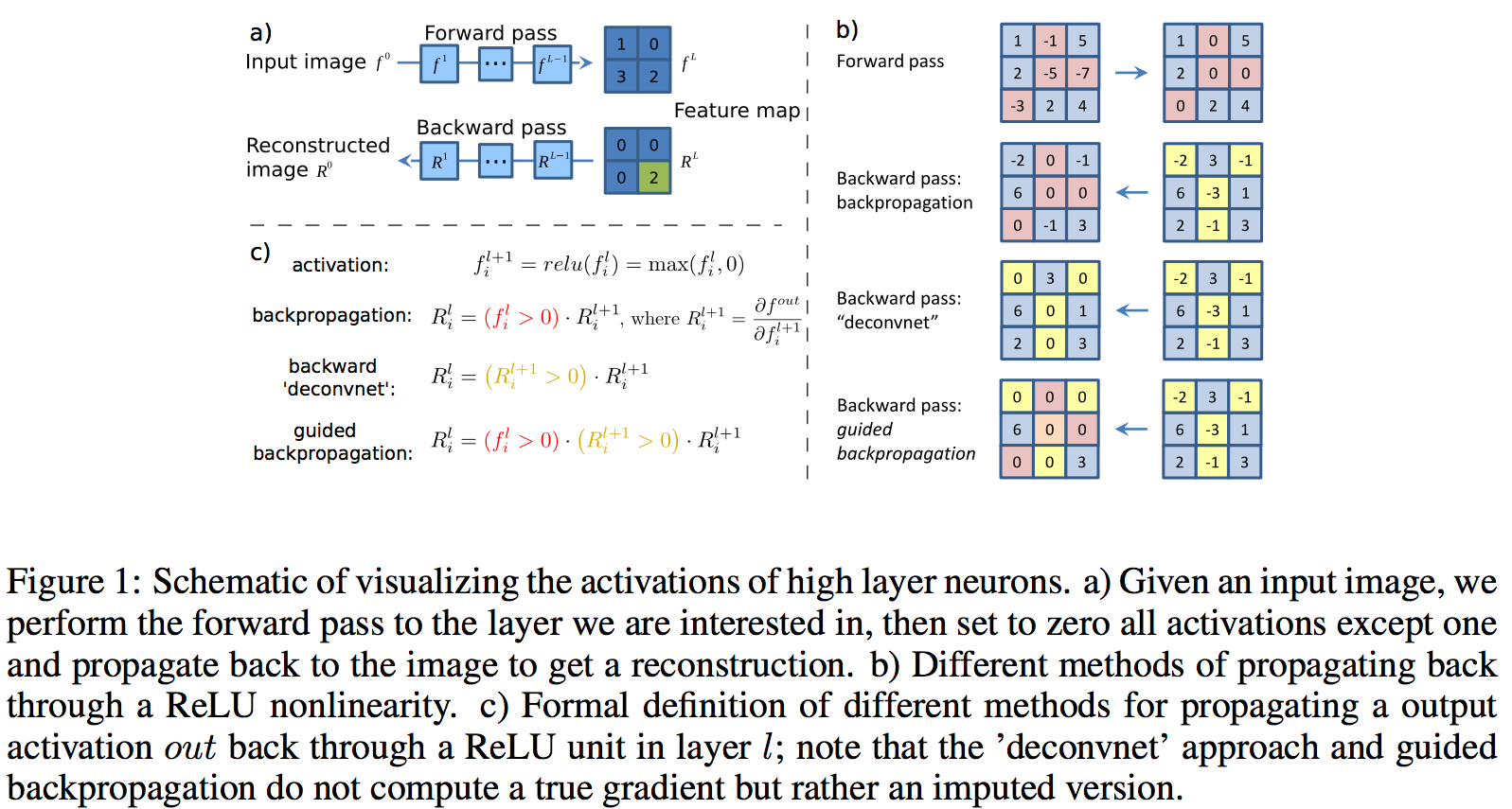
Pick a single intermediate neuron
Compute gradient of neuron value with respect to image pixels
__Gradient visualization with guided backpropagation | Deconvolution __
J. T. Springenberg, A. Dosovitskiy, T. Brox, and M. Riedmiller. Striving for Simplicity: The All Convolutional Net
Paper link
Only backprop positive gradients through each ReLU
__ Gradient Ascent | Gradient visualization with saliency maps__
K. Simonyan, A. Vedaldi, A. Zisserman. Deep Inside Convolutional Networks: Visualising Image Classification Models and Saliency Maps,
Paper Link
(Guided) backprop VS Gradient Ascent:
(Guided) backprop: Find the part of an image that a neuron responds to
Gradient Ascent: Generate a synthetic image that maximally activates a neuron
Gradient Ascent:
Initialize image to zeros
Repeat part: Forward image to compute current scores
Repeat part: Backprop to get gradient of neuron value with respect to image pixels
Repeat part: Make a small update to the image
(Guided) backprop VS Image-specific Saliency Map
Saliency Map : (Guided) backprop from one-hot class to image and compute saliency
Guided, gradient-weighted class activation mapping
R. R. Selvaraju, A. Das, R. Vedantam, M. Cogswell, D. Parikh, and D. Batra. Grad-CAM: Visual Explanations from Deep Networks via Gradient-based Localization,
paper Link
CAM: Class Activation Mapping
The weights learned in the last tensor product layer correspond to the neuron importance weights, i.e. - importance of the feature maps for each class of interest.
needs a simplified architecture, and hence has to be trained again
Grad-CAM heat-map is a weighted combination of feature maps, but followed by a ReLU: weights: global average pooling of the feature map.
Evaluation Methods
Region Perturbation / Occlustion
Deconv: Occlusion Experiments: Occlude a small square patch of the input image and then apply the network to the occluded image. Sum the responses (from one channel in the layer 5.)
Evaluating the Visualization of What a Deep Nearal Network Has Learned:
Region perturbation for ordered heatmap position: How much score is decreased by the region perturbation
Grad-CAM: Faithfulness: the ability to accurately explain the function learned by the model.
Grad-CAM++: Defined some metrics:
The capability of an explanation map in highlighting regions: occlude the parts in the unimportant region
Average confidence drop percentage
percentage of number of samples which confidence increase
RISE: Randomized Input Sampling for Explanation of Black-box Models: probability AUC curves for deletion and insertion
Injecting noise
Rotating and translating the image
Object Localization / Segmentation
CAM:
Localization Evaluation: (ILSVRC2014) bbox generation: simple thresholding by 20% of the max value and take bbox of the largest connected component. Code
GRAD-CAM:
15% of the max value as threshold
weakly supervised segmentation
Pointing-GAME: (Top-down Neural Attention by excitation Backprop)
Grad-CAM++:
Design a IoU over the area of bounding box and the heatmap
Human Trust:
Grad-CAM: class discrimination
Grad-CAM++
Learning from Explanation: Knowledge Distillation:
Grad-CAM++: Define student-teacher network by introducing interpretability loss, instead of or combine with the traditional distillation loss. The interpretability lossis the square of the distance between the CAM of the teacher net and the student net.
- Diagnosing the image classification CNNs:
Grad-CAM:
Analyzing failure modes for CNNs
Effect of adversarial noise for CNNs
Identifying bias in dataset
Counterfatual Explanations:
Grad-CAM
- Applications:
CAM:
discovering informative objects in the scenes: SUN dataset
Concept localization in weakly labeled images: hard-negative mining